Patented Human Authentication & AI Defense Platform
HCS-U7 Cognitive Cybersecurity
HCS-U7 is a patented cognitive authentication system that proves you are human — not a bot, not a replay, not an AI. 11-layer anti-mimicry detection, post-quantum cryptography, and autonomous machine learning protect your infrastructure from the most sophisticated threats.
99.5%
attack rejection rate — zero exploitable vulnerability
<1ms
ML inference latency (Brain ML v2.0)
11
independent anti-mimicry detection layers
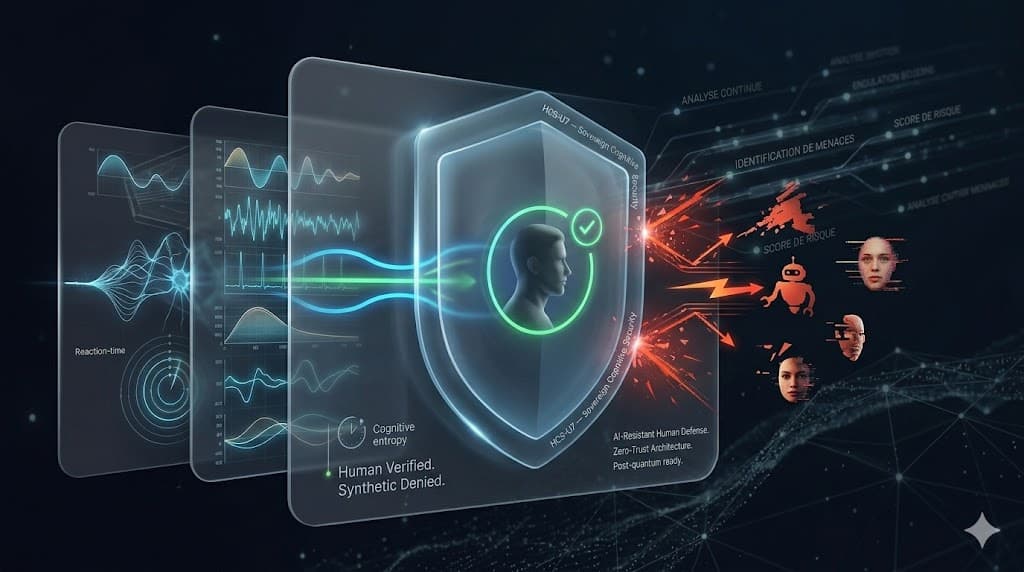
Three Pillars of Cognitive Defense
HCS-U7 goes beyond traditional cybersecurity. Our patented technology combines cognitive science, machine learning, and post-quantum cryptography to create an authentication system that cannot be fooled, replayed, or brute-forced.
Brain ML Engine
- Gradient Boosting classifier with 43-dimension behavioral feature vector
- Autonomous closed-loop: OBSERVE → ANALYZE → DECIDE → ACT → EVALUATE → DEPLOY
- Drift detection via PSI (Population Stability Index) + EWMA/CUSUM accuracy monitoring
Anti-Mimicry Defense
- 11 independent detection layers: Shannon entropy, micro-tremor, Benford's law, fractal DFA, Mahalanobis distance, replay fingerprint, cognitive drift
- V2 layers: randomized session weights, secret model parameters, adversarial simulation, adaptive calibration detection
- FAR/FRR auto-calibration across 4 sliding windows without manual labels
Post-Quantum Cryptography
- CRYSTALS-Dilithium (ML-DSA-65) quantum-resistant digital signatures — NIST FIPS 204
- CRYSTALS-Kyber (ML-KEM-768) quantum-resistant key encapsulation + AES-256-GCM — NIST FIPS 203
- Triple independent signatures: QSIG (HMAC-SHA256) + B3 (BLAKE3) + MFB (Multi-Factor Binding) with HKDF key separation
Threats We Neutralize
Attack Vectors Blocked
AI bot mimicry & credential stuffing
Advanced ML evasion strategies — naive random, learned ranges, correlation-aware, temporal-aware, statistical mimicry, adversarial optimized — all neutralized by the 11-layer anti-mimicry engine
JWT forgery & injection attacks
alg:none bypass, expired tokens, weak secrets, SQL/NoSQL injection, null byte injection, CRLF — every vector is blocked at the authentication layer
Cross-tenant & privilege escalation
IDOR, cross-tenant data access, body injection, privilege escalation — zero bypass possible across all attack surfaces
Built-in Resilience
Null byte & injection hardening
Input sanitization at every entry point. Control characters, encoding attacks, and malformed payloads are stripped before reaching any database or service layer
Timing-safe verification pipeline
ISO-CHRONIC pipeline: fixed 5-window iteration, no early return, constant-time comparison, bitwise accumulation — eliminates all timing-based side channels
Autonomous incident response
Automated detection-to-remediation pipeline: detect → diagnose → patch → deploy → verify. Mean remediation time under 19 minutes for critical vulnerabilities
HCS-U7 Architecture: Defense in Depth
Every layer of HCS-U7 is designed to be independently secure. Compromise one layer, the others hold. Cognitive challenges prove humanity, ML classifies behavior, and post-quantum cryptography ensures the code cannot be forged — even by a quantum computer.
Cognitive Authentication
Multi-domain cognitive challenges (Stroop, N-Back, RAN vocal, digit span, reaction time) generate a human identity code with 16 cryptographic segments. Behavioral fingerprinting captures passive interaction patterns. Celestial Entropy adds astronomical randomness via planetary orbital positions with a secret temporal offset.
Outcome
Each HCS-U7 code is cryptographically unique, bound to device + voice + tenant, and expires in 30-second windows.
Performance Guarantees
99.5%
Attack Rejection Rate
Every known attack vector blocked — zero exploitable vulnerability
11-layer anti-mimicry + triple signature + post-quantum cryptography
<1ms
ML Inference Latency
Real-time classification with 43-dimension feature vector
Gradient Boosting with Docker-isolated worker — CPU separation guarantees latency
<19min
Mean Remediation Time
From detection to verified production fix
Automated pipeline: detect → diagnose → patch → deploy → verify
Protection Scenarios
Bot & AI Impersonation Defense
Sophisticated AI bots attempt to mimic human behavior — learned timing patterns, correlated interactions, statistical mimicry of cognitive responses. HCS-U7's 11-layer anti-mimicry engine analyzes Shannon entropy, micro-tremors, Benford's law, fractal dimensions, and Mahalanobis distance to distinguish humans from machines with >85% block rate on every strategy.
Injection & Forgery Protection
Attackers target authentication with JWT forgery, SQL/NoSQL injection, null byte injection, CRLF manipulation, session hijacking, and prototype pollution. HCS-U7 blocks every vector at the authentication layer with input sanitization, constant-time verification, and triple independent signature validation.
Quantum-Resistant Key Protection
Future quantum computers threaten today's cryptographic standards. HCS-U7 deploys CRYSTALS-Dilithium (ML-DSA-65) for quantum-resistant signatures and CRYSTALS-Kyber (ML-KEM-768) for key encapsulation, compliant with NIST FIPS 203/204. Triple signature architecture ensures no single key compromise can break the system.
HCS-U7 Technology Stack
HCS-U7 delivers cognitive cybersecurity through a coordinated stack of patented technologies:
Brain ML v2.0
Autonomous Machine Learning Engine
Gradient Boosting classifier with 43-dimension behavioral feature vector. Autonomous closed-loop learning: observe, analyze, decide, act, evaluate, deploy — with 7-gate evaluator guard and SAFE_STATIC_MODE fail-safe.
Anti-Mimicry Engine
11-Layer Bot Detection
Shannon entropy, micro-tremor analysis, Benford's law, fractal DFA, Mahalanobis distance, replay fingerprint, cognitive drift detection. V2 adds randomized session weights, secret model parameters, and adaptive calibration.
Post-Quantum Cryptography
NIST FIPS 203/204 Compliant
CRYSTALS-Dilithium (ML-DSA-65) quantum-resistant digital signatures and CRYSTALS-Kyber (ML-KEM-768) key encapsulation with AES-256-GCM encryption. Future-proof against quantum computing threats.
Celestial Entropy
Astronomical Randomness Source
Entropy derived from real-time planetary orbital positions with a secret temporal offset. Unpredictable, non-reproducible randomness that makes each authentication code astronomically unique.
Triple Signature Architecture
Independent Cryptographic Binding
Three independent signatures per code: QSIG (temporal + cognitive + celestial), B3 (BLAKE3 canonical hash), MFB (tenant + device + voiceprint). HKDF key separation ensures compromising one never compromises the others.
Docker Worker Isolation
Secure Compute Separation
ML inference runs in isolated Docker containers with dedicated CPU allocation. Process-level isolation prevents side-channel attacks and guarantees <1ms latency for real-time classification.
Deploy Cognitive Authentication
HCS-U7 is the world's first patented cognitive authentication platform with autonomous ML, post-quantum cryptography, and 11-layer anti-mimicry defense — protecting your infrastructure against today's and tomorrow's threats.